Wednesday, April 30, 2014

Z is for Zebra, Good-bye to the 2014 A-Z Challenge!

Keeping a tradition, this was my "Z" from last year, this is JJ, a Zebra made of paper mache.  He is here again to say good-bye and thank you to all of those who made the A-Z Challenge possible, both the editors, assistants and all you bloggers out there.

Ah, but there is a French connection.  Since my theme was Edgar Degas, I needed something French.  JJ was created in Haiti, and his white coat was made with pages from a French book, then the stripes were painted over the pages.  Seeing the words in French made JJ special, I had to buy him and I did.  He is hanging in my kitchen over the doorway to the dining room.  And to further my penchant for naming inanimate objects, I looked up Haitian names online and saw, Jean-Jean or JJ.

The Internet is amazing--I learned so much about Edgar Degas but I have so much more to learn.  And I learned about other topics from all the A-Z Bloggers as well.  Now for the next few days I can leisurely read more blogs that I missed and read the familiar and new blogs I discovered.  Merci to all of you!

Jean-Jean. c. 2011,  Haiti. Artist unknown.


Monday, April 28, 2014

X is for "Madam X" by John Singer Sargent and Y is for "Yellow Dress" by Degas

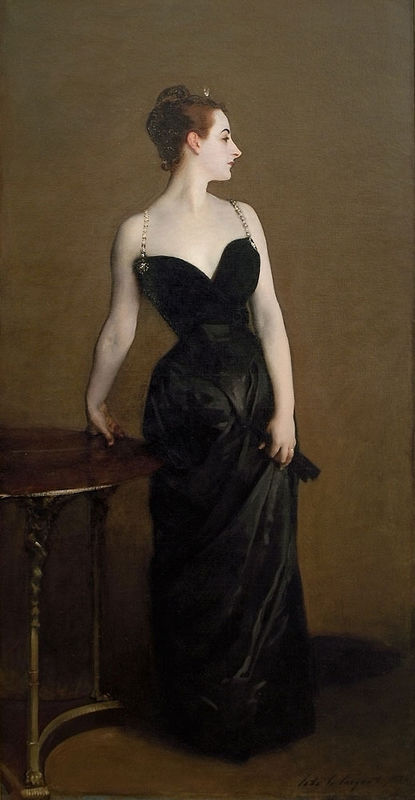
The painting on the left is by John Singer Sargent, an American Artist, called "Portrait de Mm ***" although when it was exhibited at the Paris Salon in 1884, it created a scandal.  Everyone knew who the subject was, a wealthy American who married a French banker.  Madam Gautreau was known for her beauty, and her interests were her wardrobe and her pleasures.  John Singer Sargent was entranced with her and convinced her to pose for him, although he struggled with finding the right pose and perspective and having M. Gautreau pose for him long enough to finish the painting.  Unfortunately, the painting caused a scandal.  The pose, the subject, (originally the right strap was off the shoulder), and the fact that he had not quite established himself in France, and the French, being the French, "trashed" the painting.  Sargent was devastated as was M. Gautreau.  Sargent left France a few years later, returned to England and never came back.  He considered the portrait his finest work and later sold it to the Metropolitan Museum of Art in New York. 

What led me to "Madame X" as the painting came to be known, was Edgar Degas's painting in 1890 of "Seated Woman in a Yellow Dress."  The Madame X painting flashed in my mind.  Was Degas painting the same woman?  The nose, the red hair, the haughty expression seemed to be Madam Gautreau.  Degas rendered this in pastels, and you can imagine since there was such a scandal about Sargent's painting in 1884, Degas would have heard about it and perhaps even gone to see the exhibit.  Six years later, he created his own version.  In later years, French artists painted her, and even though she was wearing revealing gowns, the paintings caused no scandal.  

I was not able to find out any information about "Seated Woman in a Yellow Dress."  This was my own idea.  What do you think?


"Portrait de Mm***" John Singer Sargent. 1883.
"Seated Woman in a Yellow Dress."  
http://www.artble.com/imgs/

Saturday, April 26, 2014

W is for "Waiting" by Edgar Degas, c.1882.

This painting by Edgar Degas, actually done in pastel on beige laid paper, was not seen in public until 1983, before that date it was in a private collection.  Now it is owned jointly by the Norton Simon Museum and the J.P. Getty Museum in Pasadena, California.

Here we see a contrast between two figures, old and young, a ballerina and her chaperone.  "Waiting" is a thoughtful title, the ballerina waiting to go on the stage for performance or rehearsal, and her chaperone waiting for her to dance and then escort her home.  Meanwhile, the chaperone is drawing circles in the floor with her umbrella, probably bored by the whole thing.  And of course, this is a painting, like a novel, and could have been a composite from Degas's imagination.  But waiting could mean so many things, but the contrast in ages, as depicted by Degas, makes this painting an interesting one to study.


"Waiting" by Edgar Degas, c. 1882.  Pastel on paper.  Dover Press.  Mineola, New York.